
Control variation events before they become project problems
VET helps project teams capture, assess, route, approve, track, and close variation events with clear links to scope, schedule, cost, documents, stakeholders, decisions, and downstream impacts.
Why variation events need to be tracked early
Variation events often begin before a formal change order, claim, or dispute exists. They may start as a site instruction, design clarification, field condition, late approval, changed quantity, coordination issue, procurement delay, or project decision.
If these events are not captured early, the project team can lose the connection between the original trigger, affected work, supporting records, stakeholder responses, schedule impact, cost impact, and final outcome.
VET gives teams a structured way to record variation events at the source, before the project story becomes fragmented or difficult to reconstruct.
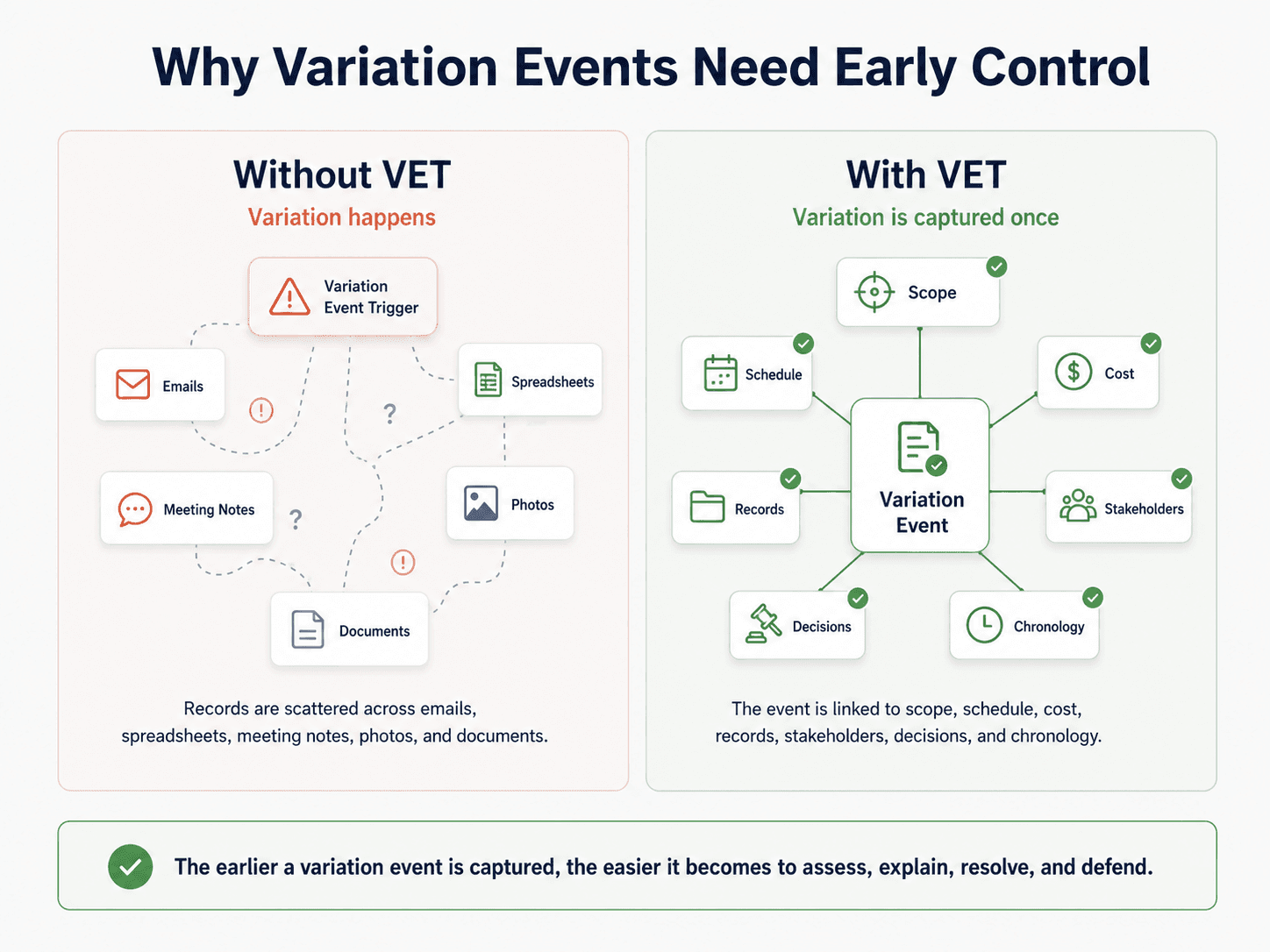
VET is the central engine of Novologic's variation management workflow. It captures variation events and connects them to causes, scope impacts, time impacts, cost impacts, stakeholders, documents, notices, and downstream effects.
Variation management protocol
A variation event may begin as a cause or trigger: a field condition, design clarification, late approval, instruction, quantity change, procurement issue, or coordination problem.
VET helps teams record that trigger early and connect it to the effects that follow across scope, time, cost, documents, stakeholders, and downstream work.
This gives project teams a clearer way to understand not only that a change occurred, but why it happened, what it affected, and how it should be managed.
How DCOD arising from Variations spirals out in construction projects
DCOD stands for Delay, Cost Overrun, and Dispute— the escalation chain that unmanaged variation events tend to follow. VET is built to interrupt this chain by capturing variations at the source, before a small issue becomes an expensive one.
100%
of Projects
experience Variations
$22,000 per day
Average cost of delay

90%
of Projects
experience Delays

95%
of Projects
encounter Cost Overruns

60%
of Projects
face Disputes
The cost of DCOD to the industry
Delay, cost overrun, and dispute are not edge cases — they represent a significant share of global construction spend lost every year to problems that often began as small, uncaptured variations.
~$550B
estimated annual loss from DCOD
~$2.45T
global construction industry
Inside a VET record
Each variation event is a connected record, not a single form. Explore the dashboards that link status, workflow, chronology, schedule logic, references, attachments, and outcomes. Click any screen to zoom in.
VE Record Overview
Every variation event opens with live status, key counts, and a status-over-time view.
From capture to closeout
Once a variation event is created, VET moves it through a structured workflow so the issue can be reviewed, assessed, routed, tracked, and closed with a complete project record.
Each step helps the team maintain visibility over the event, the supporting evidence, the people involved, the impacts identified, and the decisions made.
Capture
Create the variation event early with the subject, description, source, date, project area, and initial supporting information.
Assess
Review the possible scope, schedule, cost, labour, material, equipment, productivity, and downstream impacts.
Route
Assign the event to the right stakeholders, reviewers, approvers, viewers, and recipients.
Track
Monitor status, open actions, comments, responses, approvals, criticality, and unresolved risk.
Close
Record the final outcome, link supporting documents, update chronology, preserve audit trail, and support reporting.
Experience VET today
VET helps teams understand project status, preserve project memory, improve accountability, and manage variation events before they become expensive delays, cost overruns, disputes, or claims.